
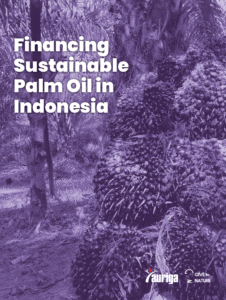
Give to Nature and Indonesian partner Auriga Nusantara have jointly released a new research report (click here to read) on sustainable palm oil financing in Indonesia, alongside a complementary study by the International Institute of Green Finance (IIGF) on green finance mechanisms supporting China’s palm oil trade. The dual reports were presented and discussed at a closed-door seminar co-hosted by Give to Nature in Xiamen on April 16, 2026, convening Chinese financial institutions, insurers, customs and trade representatives, and industry experts, together with Auriga Nusantara as the Indonesian partner.
The combined research provides a dual perspective across supply- and demand-side dynamics of China–Indonesia palm oil trade, highlighting both progress in regulatory alignment and persistent structural barriers to scaling sustainable finance. Key challenges identified include fragmented sustainability standards, high certification costs, limited interoperability of data systems, and weak transmission of “green” incentives across supply chains.
A central outcome of the Xiamen dialogue was broad consensus on the need for a minimum shared framework for sustainable palm oil trade—anchored in zero-deforestation, traceability, and smallholder inclusion. Participants emphasized that such a framework must be supported by interoperable data infrastructure and aligned financial mechanisms capable of translating sustainability performance into actionable and bankable signals for financial institutions.
The discussion further underscored the importance of innovation in green trade finance, particularly in redesigning working capital financing, strengthening cross-border information sharing, and improving coordination between policy, financial, and certification systems. Reducing certification costs and enhancing mutual recognition of standards were identified as critical enablers to lower transaction frictions and improve scalability.
Looking ahead, participants outlined several priority action areas, including piloting bilateral “white list” recognition systems for certified sustainable palm oil, advancing green working capital and risk-sharing financing pilots with banking and insurance partners, and developing collaborative approaches to reduce certification costs through multi-stakeholder engagement.
The Xiamen meeting marked an important step in translating joint research into actionable pathways, reinforcing the shared commitment of China and Indonesia stakeholders to build more transparent, efficient, and financeable sustainable palm oil supply chains.