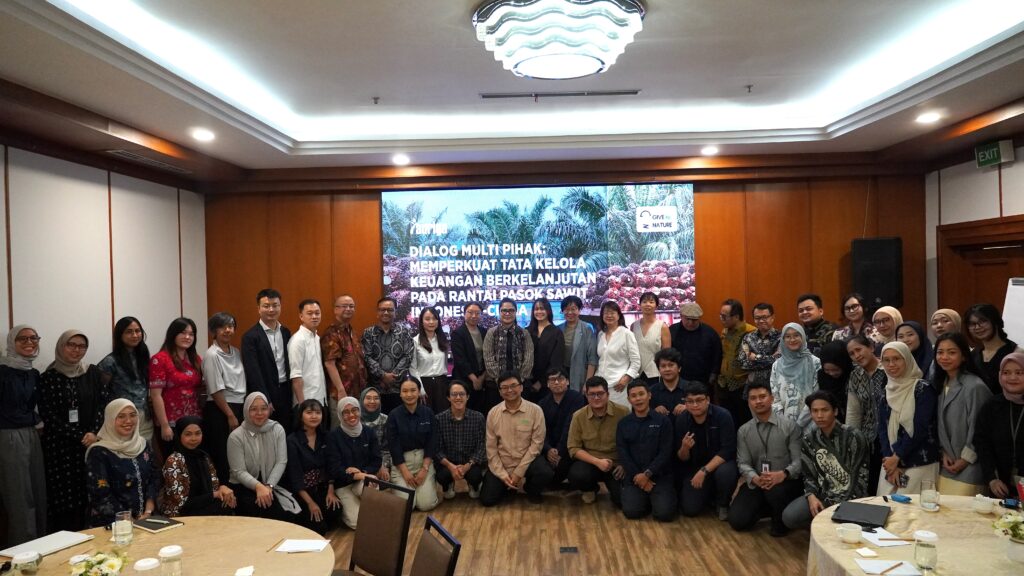
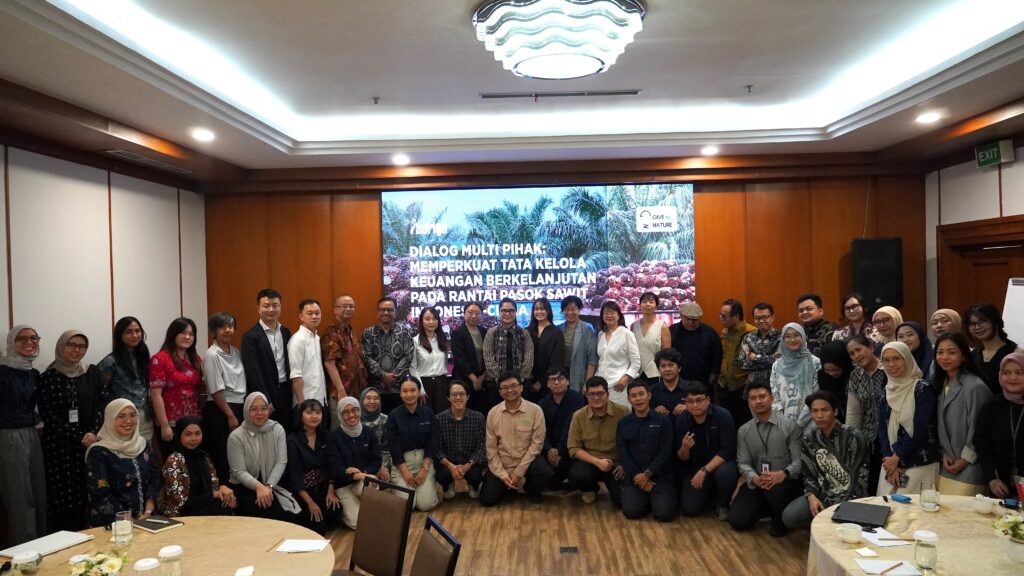
Jakarta, 7 July 2026 — Auriga Nusantara and Give to Nature (G2N) convened a cross-institutional policy session in Jakarta to bridge the gap between sustainable palm oil production and cross-border green finance. The meeting followed an April 2026 session in Xiamen and brought together Indonesian regulators, Chinese market representatives, banks, and smallholder associations.
Timer Manurung of Auriga Nusantara opened by noting that roughly 93% of Indonesia’s current palm oil cover did not originate from forested areas as of the year 2000, arguing that the majority of production should already meet international market expectations. Jingwei Zhang of Give to Nature, speaking for the Chinese contingent, welcomed the dialogue and pointed out that without clear price premiums for sustainable palm oil, broader adoption remains difficult.
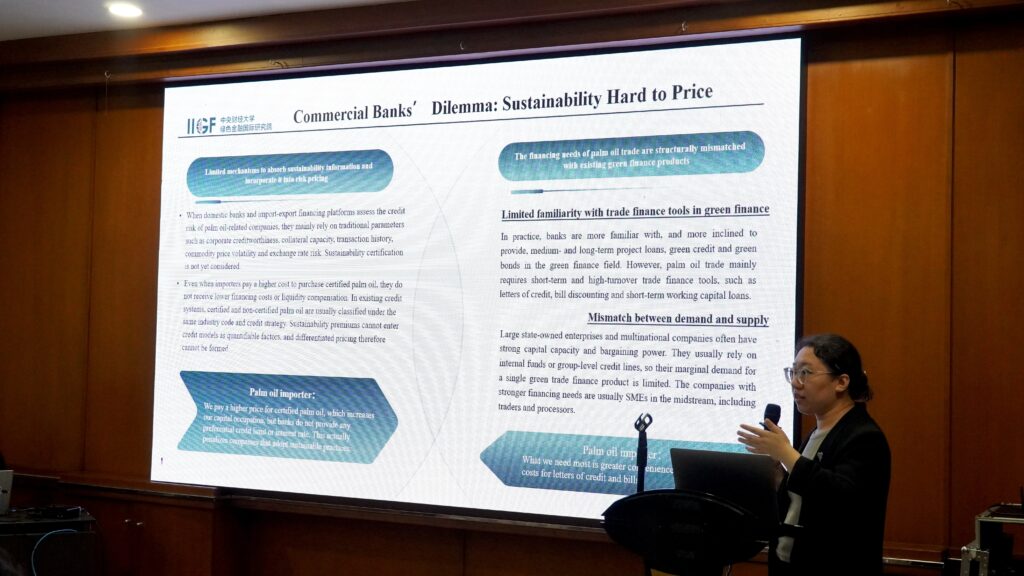
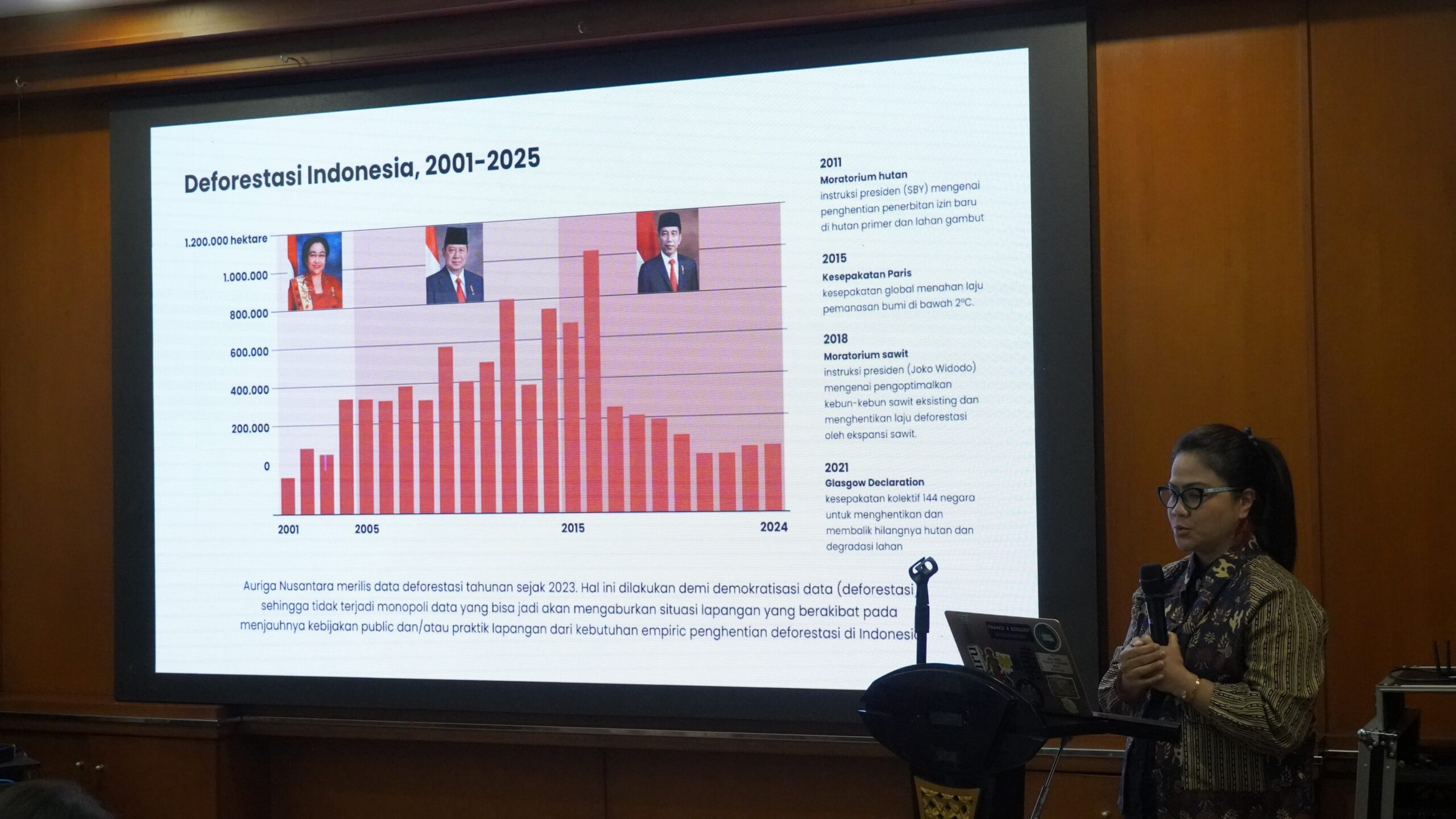
Rahmawati Retno Winarni of Auriga Nusantara presented evidence that CPO production has largely decoupled from deforestation, with output reaching approximately 47 million tonnes in 2023, but cautioned that a sharp rebound in 2025—especially in Papua—shows frontier risk remains. Adelina Chandra of Trase.Earth followed by noting that over half of deforestation exposure is concentrated in just 12 regencies, making targeted due diligence possible only if traceability data is credible and field-verified. Ms. Zhengyun Zhou of the International Institute of Green Finance (IIGF) highlighted a structural disconnect: while RSPO and ISPO standards exist, they are not integrated into financial systems, and China’s project-based green finance framework largely excludes agriculture.
For discussion, Ms. Chen Ying of the China Customs Brokers Association observed that China’s import decisions will increasingly hinge on sustainability and compliance, not only price. Aloysius Suratin of RSPO Indonesia stressed that due diligence must move beyond aggregate data to spatially traceable, field-validated information, and that smallholder incentives should be tied to documented performance rather than moral appeals.
Fredi Firmansyah of Bank Indonesia outlined national tools including TKBI and the Green Cloud Calculator, noting that the Green Macro-Prudential Policy (Green KLM) has reached roughly IDR 400 trillion, and that Indonesia is exploring taxonomy alignment with Singapore and China. Fitrian Ardiansyah of ADM Capital warned that Indonesia’s sustainability initiatives remain fragmented, reported that pilot Sustainability Linked Loans tied to deforestation reduction are underway with banks, and suggested a taxonomy exchange mechanism between Indonesia, ASEAN, and China.
Luthfyana Larasati of Climate Policy Initiative (CPI) described TKBI as an important transparency tool but emphasized that cross-sector collaboration must deepen to improve data quality and accountability. Sabar of the Union of Oil Palm Smallholders (SPKS), representing 5,000 independent smallholders, stressed that certification costs remain high while no price premium reaches the farm level, and said SPKS is actively seeking Chinese buyers for its certified volumes.

Closing
Participants concluded that standards already exist; the priority now is credible data, proportionate burdens for smallholders, and using China’s emerging green trade frameworks to align cross-border finance with sustainable supply chains.
Next Steps
- Taxonomy alignment. Explore how Indonesia’s TKBI, Singapore’s taxonomy, China’s green bond catalogue, and the ASEAN framework treat palm oil and land-use activities, and look for opportunities to improve mutual recognition across jurisdictions.
- Certification cost analysis. Examine the full cost burden of RSPO and ISPO for smallholders and cooperatives against the market returns they currently receive, to better understand where financing support or incentive mechanisms could help close the gap.
- ISPO–Xiamen alignment. Look into how Indonesia’s ISPO standards and China’s Xiamen green agriculture certification might be brought closer together, with an eye toward reducing duplicate audit burdens for cooperatives that already meet one set of requirements.
- Smallholder pipeline. Deepen collaboration with farmer networks and local partners to strengthen mapping, financial literacy, and cooperative capacity in priority areas, while opening conversations with Chinese buyers to create a clearer market pathway for certified smallholder produce.